Description du produit
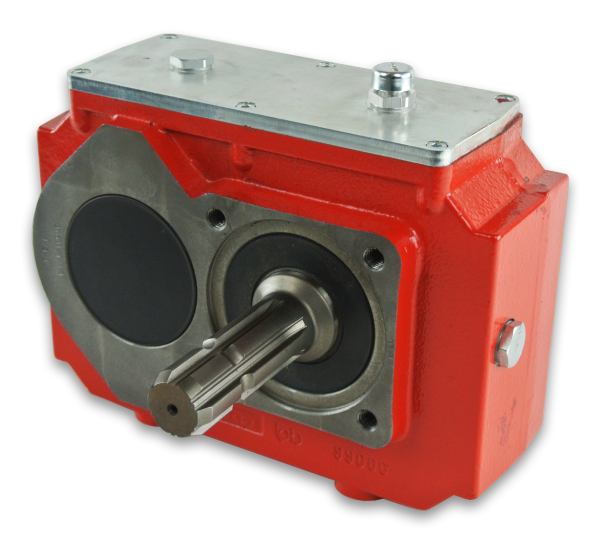
RC 51 Rotary Cutter Bevel pto Gearbox for Lawn Mower Finishing Mower Rotary Slashers Replacement of Omni Code RC-51
Torque: 2,800-4,667-in.
316-527 Nm.
Scale: 1:1. 47, 1:1.71, 1:1. 93
Seal: 3 lip spring loaded
Bearing: tapered roller/deep groove ball
Oil cap :27 oz. (0.80L)
Weight :56 pounds. (25.4 kg)
Application
Finishing lawn mower, rotary cutter, rotary cutter, top machine
Our Factory:
1. Shell: made of high rigidity fc-25 cast iron;
2. Gear: high purity alloy steel 20crmnt is used for quenching and tempering, carburizing, quenching and grinding;
3. Spindle: high purity alloy steel 40Cr quenching and tempering processing, with high hanging load capacity.
4. Bearing: equipped with tapered roller bearing with heavy load capacity;
5. Oil seal: imported double lip oil seal, with the ability of dust and oil leakage.
Product lubrication:
The use of proper lubricating oil for t spiral bevel gear commutator can give full play to the efficiency of the steering gear and improve its service life.
1. The initial wear period is 2 weeks or 100-200 hours. There may be a small amount of metal wear particles between them. Please clean the interior and replace it with new lubricating oil;
2. In case of long-term use, change the lubricating oil every half a year or 1000-2000 hours.
Technical parameters of T spiral bevel gear commutator:
It can be equipped with single horizontal axis, double horizontal axis, single vertical axis and double vertical axis 1:5, 1:5, 1:1, 1:5, 1:5, 1:1
Related products:
Application:
Company Profile:
Services
Also I would like to take this opportunity to give a brief introduction of our CHINAMFG company:
Our company is a famous manufacturer of agriculture gearbox,worm reduce gearbox, PTO shafts, Sprockets ,rollar chains, bevel gear, pulleys and racks in china.
We have exported many products to our customers all over the world, we have long-time experience and strong technology support.
-Ø Our Company with over 12 year’s history and 1000 workers and 20 sales.
-Ø With over 100 Million USD sales in 2017
-Ø With advance machinery equipments
-Ø With large work capacity and high quality control, ISO certified.
……
You also can check our website to know for more details, if you need our products catalogue, please contact with us.
| Application: | Motor, Electric Cars, Motorcycle, Machinery, Marine, Agricultural Machinery, Car |
|---|---|
| Function: | Distribution Power, Clutch, Change Drive Torque, Change Drive Direction, Speed Changing, Speed Reduction, Speed Increase |
| Layout: | Coaxial |
| Hardness: | Hardened Tooth Surface |
| Installation: | Horizontal Type |
| Step: | Three-Step |
| Exemples : |
US$ 9999/Piece
1 pièce (commande minimale) | |
|---|
Difficultés liées à l'utilisation des boîtes de vitesses à engrenages coniques
Bien que les réducteurs à onglets offrent divers avantages, ils présentent également certains défis qu'il convient de relever :
Lubrification: Une lubrification adéquate est essentielle au bon fonctionnement des réducteurs d'engrenages à onglets afin de minimiser la friction, la chaleur et l'usure entre les dents. Assurer une lubrification constante et suffisante dans le réducteur peut s'avérer complexe, notamment dans les espaces confinés ou difficiles d'accès.
Entretien: Les réducteurs d'onglet nécessitent un entretien périodique pour garantir leur fonctionnement optimal et leur longévité. Cet entretien peut comprendre la vérification et le remplissage du lubrifiant, l'inspection de l'usure des dents d'engrenage et la correction de tout problème d'alignement ou de montage pouvant survenir au fil du temps.
Contrecoup: Le jeu, ou espace entre les dents d'un engrenage, peut affecter la précision de la transmission du mouvement. Un jeu excessif peut entraîner une perte de précision et des erreurs de positionnement dans les applications exigeant une grande exactitude.
Conception complexe : Les réducteurs à onglets présentent une conception plus complexe que d'autres types de réducteurs, ce qui peut rendre leur fabrication, leur assemblage et leur maintenance plus difficiles. Cette complexité peut également engendrer des coûts de fabrication et de maintenance plus élevés.
Perte d'efficacité : Les réducteurs à engrenages coniques peuvent subir des pertes d'efficacité dues à des facteurs tels que le frottement et le défaut d'alignement. Ces pertes peuvent réduire le rendement global de la transmission de puissance, entraînant un gaspillage d'énergie.
Contraintes d'espace : Dans certaines applications, les contraintes d'espace peuvent constituer un défi lors de l'intégration de réducteurs à onglet, notamment lorsque des rapports de transmission plus importants sont nécessaires pour obtenir le changement de direction de mouvement souhaité.
Charges de choc : Les applications soumises à des chocs soudains ou à des forces d'impact importantes peuvent poser des problèmes aux réducteurs à onglets. Des mesures adéquates, telles que l'utilisation de composants amortisseurs ou une conception renforcée pour une durabilité accrue, peuvent s'avérer nécessaires pour y remédier.
Alignement et montage : Un alignement et un montage corrects des réducteurs d'angle sont essentiels pour garantir un fonctionnement optimal et prévenir une usure prématurée. Obtenir un alignement précis peut s'avérer complexe, notamment dans les installations à accès limité ou aux géométries complexes.
Considérations relatives aux coûts : La complexité de conception et les exigences de fabrication des réducteurs à onglets peuvent engendrer des coûts plus élevés que pour les réducteurs plus simples. Il est donc essentiel, lors du choix d'un réducteur à onglets, de bien évaluer les avantages et les coûts associés.
Relever ces défis exige souvent une ingénierie rigoureuse, des pratiques de maintenance appropriées et la prise en compte des exigences spécifiques de chaque application. Malgré ces difficultés, les réducteurs à onglets demeurent des composants essentiels dans divers secteurs industriels où leur capacité unique à inverser le sens de rotation est un atout.
Miter Gearboxes in Robotics and Automation Applications
Miter gearboxes are indeed utilized in robotics and automation applications, leveraging their unique capabilities for precise motion control and direction change:
Precision Motion: In robotics, miter gearboxes can be employed to achieve precise and accurate motion at right angles, allowing robots to perform intricate tasks with accuracy.
Joint and Arm Movements: Robotic arms often require precise movement and control at various angles. Miter gearboxes enable smooth and controlled motion changes, contributing to the versatility of robotic arms.
Direction Change: Many automation systems involve the need to change the direction of motion, such as conveyors or assembly lines. Miter gearboxes efficiently handle these changes, ensuring seamless operation.
Space Optimization: Robots and automated systems often operate in confined spaces. Miter gearboxes’ compact design makes them suitable for integrating into space-constrained environments.
Responsive Control: Automation applications demand responsiveness and accurate control. Miter gearboxes provide the necessary motion control for timely and precise execution of tasks.
Noise Reduction: In robotics and automation, quiet operation is essential. Miter gearboxes, with reduced backlash and noise, contribute to a quieter working environment.
Miter gearboxes play a crucial role in enhancing the efficiency, accuracy, and versatility of robotics and automation systems by facilitating controlled motion changes and direction shifts.
Miter Gearbox: Function and Mechanism
A miter gearbox, also known as a bevel gearbox or angle gearbox, is a type of gearbox that transmits power and changes the direction of rotational motion between intersecting shafts positioned at a 90-degree angle to each other. It consists of a set of bevel gears with intersecting axes.
The function of a miter gearbox in mechanical systems is to redirect the rotational motion of input shaft(s) to output shaft(s) at a right angle. This allows for power transmission and torque conversion between two shafts that are not aligned. Miter gearboxes are particularly useful when space constraints or specific mechanical configurations require a change in the direction of motion.
The working principle of a miter gearbox involves the meshing of bevel gears. Bevel gears have conically shaped teeth that enable them to mesh smoothly at a 90-degree angle. When the input shaft rotates, the teeth of the input bevel gear engage with the teeth of the output bevel gear, causing the output shaft to rotate perpendicularly to the input shaft. The gear ratio and number of teeth on the gears determine the speed and torque conversion between the input and output shafts.
Miter gearboxes find applications in various industries, such as automotive, machinery, agriculture, and robotics, where changes in motion direction are required. They are often used in equipment that needs to transmit power around corners or in tight spaces while maintaining the desired torque and speed characteristics.


editor by CX 2023-09-15