The primary benefit of worm gears is their capability to provide high reduction ratios and correspondingly high torque multiplication. They can also be applied as acceleration reducers in low- to medium-quickness applications. And, because their reduction ratio is based on the amount of gear teeth alone, they are smaller sized than other types of gears. Like fine-pitch business lead screws, worm gears are usually self-locking, which makes them perfect for hoisting and lifting applications.
Although the sliding contact reduces efficiency, it provides extremely quiet operation. (The usage of dissimilar metals for the worm and gear also plays a part in quiet operation.) This makes worm gears well suited for use where noises should be minimized, such as in elevators. Furthermore, the usage of a softer materials for the gear means that it can absorb shock loads, like those knowledgeable in heavy equipment or crushing devices.
The meshing of the worm and the gear is an assortment of sliding and rolling actions, but sliding contact dominates at high reduction ratios. This sliding actions causes friction and temperature, which limits the effectiveness of worm gears to 30 to 50 percent. As a way to minimize friction (and for that reason, warmth), the worm and equipment are constructed of dissimilar metals – for example, the worm may be made of hardened steel and the gear made of bronze or aluminum.
Just like a ball screw, the worm in a worm gear could have a single start or multiple starts – and therefore there are multiple threads, or helicies, on the worm. For a single-start worm, each complete change (360 degrees) of the worm increases the gear by one tooth. So a gear with 24 teeth will provide a gear reduction of 24:1. For a multi-commence worm, the apparatus reduction equals the quantity of teeth on the gear, divided by the amount of begins on the worm. (That is different from most other types 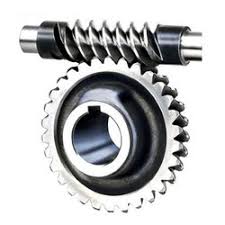 of gears, where the gear reduction is normally a function of the diameters of the two components.)
Dive right into Worm Gear Shaft with the information on our website.