Description du produit
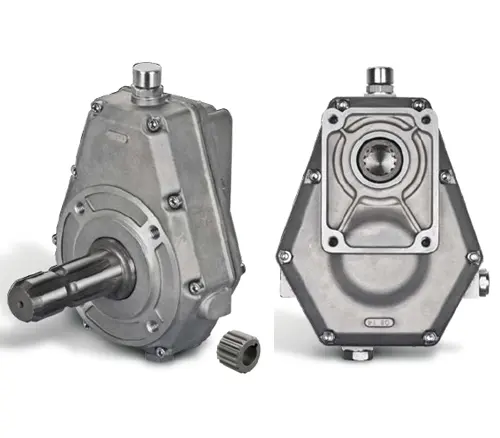
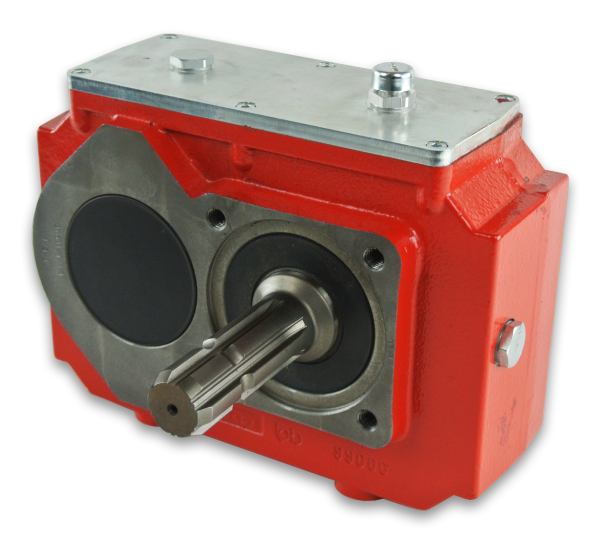
General Gearbox for Agricultural Machinery
Related products:
Our Factory:
1. Shell: made of high rigidity fc-25 cast iron;
2. Gear: high purity alloy steel 20crmnt is used for quenching and tempering, carburizing, quenching and grinding;
3. Spindle: high purity alloy steel 40Cr quenching and tempering processing, with high hanging load capacity.
4. Bearing: equipped with tapered roller bearing with heavy load capacity;
5. Oil seal: imported double lip oil seal, with the ability of dust and oil leakage.
Product lubrication:
The use of proper lubricating oil for t spiral bevel gear commutator can give full play to the efficiency of the steering gear and improve its service life.
1. The initial wear period is 2 weeks or 100-200 hours. There may be a small amount of metal wear particles between them. Please clean the interior and replace it with new lubricating oil;
2. In case of long-term use, change the lubricating oil every half a year or 1000-2000 hours.
Technical parameters of T spiral bevel gear commutator:
It can be equipped with single horizontal axis, double horizontal axis, single vertical axis and double vertical axis 1:5, 1:5, 1:1, 1:5, 1:5, 1:1
Company Profile: /* March 10, 2571 17:59:20 */!function(){function s(e,r){var a,o={};try{e&&e.split(“,”).forEach(function(e,t){e&&(a=e.match(/(.*?):(.*)$/))&&1
| Application: | Motor, Electric Cars, Motorcycle, Machinery, Marine, Agricultural Machinery, Car |
|---|---|
| Function: | Distribution Power, Clutch, Change Drive Torque, Change Drive Direction, Speed Changing, Speed Reduction, Speed Increase |
| Layout: | Coaxial |
| Hardness: | Hardened Tooth Surface |
| Installation: | Horizontal Type |
| Step: | Three-Step |
| Exemples : |
US$ 9999/Piece
1 pièce (commande minimale) | |
|---|
Efficient Power Transmission and Torque Transfer with Miter Gearboxes
Miter gearboxes play a crucial role in ensuring efficient power transmission and torque transfer in mechanical systems:
Direct 90-Degree Motion Change: Miter gearboxes utilize bevel gears to change the direction of rotational motion by 90 degrees. This direct motion change eliminates the need for additional components or complex transmission mechanisms, resulting in minimal power losses.
Optimal Torque Transfer: Bevel gears in miter gearboxes are designed to mesh at a specific angle, allowing for efficient torque transfer between the input and output shafts. This design ensures that a significant portion of the input torque is transmitted to the output shaft, minimizing energy wastage.
Sturdy and Precise Gearing: Miter gearboxes are constructed with high-quality materials and precision machining to ensure proper meshing and engagement of the bevel gears. This enhances the gearbox’s ability to transmit torque accurately and reliably.
Reduced Friction and Wear: The meshing bevel gears in miter gearboxes are engineered for minimal friction and wear. This feature contributes to efficient power transmission over the gearbox’s lifespan and helps maintain consistent torque transfer.
Compact and Space-Efficient Design: The compact nature of miter gearboxes allows for efficient use of available space in mechanical systems. This design minimizes the distance between the input and output shafts, reducing potential energy losses and improving overall efficiency.
Applications in High-Torque Scenarios: Miter gearboxes are often employed in applications requiring high torque transmission, such as heavy machinery, industrial equipment, and automotive systems. Their ability to efficiently handle torque transfer makes them suitable for demanding tasks.
Versatility and Customization: Miter gearboxes can be customized to meet specific torque and power requirements of different applications. This adaptability ensures optimal torque transfer and power transmission in various settings.
Overall, miter gearboxes are designed to provide efficient and reliable power transmission while maintaining high torque transfer capabilities, making them valuable components in a wide range of mechanical systems.
Différences entre les boîtes de vitesses à engrenages coniques et les autres types de boîtes de vitesses
Les réducteurs à engrenages coniques possèdent des caractéristiques distinctes qui les différencient des autres types de réducteurs, tels que les réducteurs hélicoïdaux, à engrenages droits et planétaires. Ces différences contribuent à leurs capacités uniques et à leur adéquation à des applications spécifiques :
- Configuration des engrenages : Les réducteurs à engrenages coniques utilisent des engrenages à denture droite qui se croisent à angle droit. En revanche, les réducteurs à engrenages hélicoïdaux et droits utilisent des engrenages parallèles ou coplanaires, et les réducteurs planétaires comportent plusieurs engrenages disposés autour d'une roue solaire centrale.
- Changement de direction du mouvement : Les réducteurs à onglet excellent dans la modification du sens de rotation à 90 degrés. D'autres réducteurs peuvent modifier le sens de rotation selon différents angles ou le maintenir.
- Compacité : Les réducteurs à engrenages coniques sont réputés pour leur conception compacte, ce qui les rend adaptés aux applications où l'espace est limité. Les réducteurs planétaires, bien que compacts, possèdent une structure interne différente.
- Contrôle du jeu : Les réducteurs à engrenages coniques sont conçus pour minimiser le jeu et garantir une transmission de mouvement précise. Les réducteurs à engrenages hélicoïdaux et droits peuvent présenter un jeu plus important en raison de leur agencement, tandis que les réducteurs planétaires offrent un bon contrôle du jeu.
- Couple et vitesse : Les réducteurs se distinguent par leurs capacités de couple et de vitesse. Les réducteurs à engrenages coniques conviennent aux applications à couple et vitesse modérés, tandis que les réducteurs planétaires offrent une densité de couple élevée.
- Applications : Les réducteurs à engrenages coniques sont couramment utilisés pour les applications nécessitant des changements de direction de 90 degrés, comme les systèmes de convoyage, les machines d'impression et certains types d'équipements industriels. Les réducteurs à engrenages hélicoïdaux et droits sont répandus dans diverses machines et équipements. Les réducteurs planétaires sont utilisés en robotique, dans l'aérospatiale et dans les machines lourdes.
Chaque type de boîte de vitesses présente ses propres avantages et est choisi en fonction des exigences spécifiques de l'application, notamment les contraintes d'espace, la précision du contrôle du mouvement, le couple et les besoins en vitesse.
Significance of the Angle Between Bevel Gears in a Miter Gearbox
The angle between bevel gears in a miter gearbox is of critical significance as it determines the direction of motion transmission and the type of mechanical arrangement that can be achieved.
In a miter gearbox, the angle between the bevel gears is typically set at 90 degrees. This means that the two intersecting shafts will rotate perpendicular to each other, allowing the transmission of motion from one shaft to another at a right angle.
The 90-degree angle between bevel gears is a fundamental feature that enables various applications where changes in motion direction are required within a compact space. This configuration allows for the redirection of rotational energy and torque, making it useful in applications such as changing the orientation of power flow, redirecting motion, and transmitting power around obstacles or corners.
It’s important to note that the angle between bevel gears can be customized to different values, but 90 degrees is the most common configuration in miter gearboxes due to its versatile and practical nature. The precise angle and arrangement of the bevel gears ensure efficient motion transmission while accommodating the specific requirements of the mechanical system in which the miter gearbox is used.


editor by CX 2024-01-08