Introduction
A cautious evaluation of the problems surrounding a conveyor is important for exact conveyor chain variety. This section discusses the fundamental considerations necessary for productive conveyor chain selection. Roller Chains are often used for light to reasonable duty materials managing applications. Environmental circumstances could need the use of exclusive materials, platings coatings, lubricants or even the potential to operate with out extra external lubrication.
Primary Info Needed For Chain Variety
? Type of chain conveyor (unit or bulk) which include the technique of conveyance (attachments, buckets, by means of rods etc).
? Conveyor layout together with sprocket areas, inclines (if any) as well as amount of chain strands (N) to become used.
? Amount of material (M in lbs/ft or kN/m) and type of material for being conveyed.
? Estimated weight of conveyor elements (W in lbs/ft or kN/m) such as chain, slats or attachments (if any).
? Linear chain pace (S in ft/min or m/min).
? Environment during which the chain will operate including temperature, corrosion circumstance, lubrication problem and so forth.
Phase one: Estimate Chain Stress
Use the formula beneath to estimate the conveyor Pull (Pest) then the chain stress (Check). Pest = (M + W) x f x SF and
Test = Pest / N
f = Coefficient of Friction
SF = Speed Issue
Phase 2: Produce a Tentative Chain Assortment
Using the Check worth, produce a 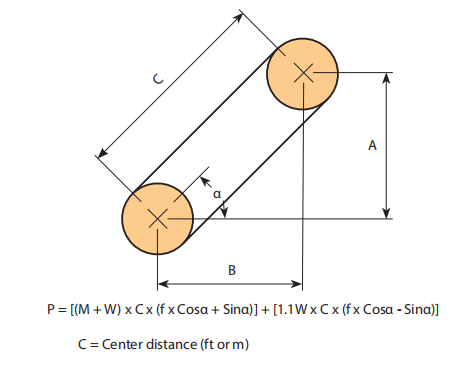 tentative variety by deciding on a chain
whose rated doing work load greater than the calculated Test value.These values are suitable for conveyor service and therefore are diff erent from individuals proven in tables on the front of the catalog which are related to slow velocity drive chain utilization.
Moreover to suffi cient load carrying capability typically these chains have to be of the selected pitch to accommodate a preferred attachment spacing. One example is if slats are to be bolted to an attachment each one.five inches, the pitch from the chain picked must divide into one.5?¡À. Thus 1 could use a forty chain (1/2?¡À pitch) with all the attachments every single 3rd, a 60 chain (3/4?¡À pitch) with all the attachments just about every 2nd, a 120 chain (1-1/2?¡À pitch) with all the attachments every pitch or possibly a C2060H chain (1-1/2?¡À pitch) together with the attachments every pitch.
Step 3: Finalize Variety – Determine Real Conveyor Pull
After making a tentative variety we have to verify it by calculating
the actual chain stress (T). To carry out this we should fi rst calculate the actual conveyor pull (P). Through the layouts proven to the suitable side of this webpage decide on the acceptable formula and determine the total conveyor pull. Note that some conveyors could possibly be a mixture of horizontal, inclined and vertical . . . in that situation determine the conveyor Pull at every single area and add them with each other.
Step 4: Determine Highest Chain Tension
The utmost Chain Stress (T) equals the Conveyor Pull (P) as calculated in Phase 3 divided through the amount of strands carrying the load (N), occasions the Pace Factor (SF) shown in Table 2, the Multi-Strand Factor (MSF) shown in Table 3 as well as the Temperature Component (TF) shown in Table four.
T = (P / N) x MSF x SF x TF
Phase five: Check the ?¡ãRated Doing work Load?¡À in the Selected Chain
The ?¡ãRated Operating Load?¡À in the selected chain need to be better compared to the Optimum Chain Tension (T) calculated in Stage four over. These values are appropriate for conveyor services and are diff erent from those proven in tables on the front on the catalog which are related to slow speed drive chain usage.
Step six: Check out the ?¡ãAllowable Roller Load?¡À of your Chosen Chain
For chains that roll over the chain rollers or on prime roller attachments it is actually necessary to check the Allowable Roller Load?¡À.
Note: the Roller load is established by:
Roller Load = Wr / Nr
Wr = The total fat carried from the rollers
Nr = The number of rollers supporting the weight.